Research
Lines of Research
-
*
Horizontal gene transfer as a source of evolutionary innovation in metazoans
Bdelloid rotifers carry an unusual proportion of coding sequence of non-metazoan (mostly bacterial) origin. That makes them a natural experiment in what foreign genes actually do once they are in an animal genome.
One answer is that they can be built into the host's own regulatory systems. Bdelloids lack the canonical eukaryotic C5-methyltransferases, but encode N4CMT, an amino-methyltransferase captured from bacteria more than 60 million years ago, which deposits N4-methylcytosine at active transposons and certain tandem repeats. Another answer is chemical defense: bdelloids under attack by a fungal pathogen express horizontally acquired biosynthetic gene clusters resembling bacterial antibiotic pathways.
Nat Commun 2022 · Nat Commun 2024 · BioEssays 2023
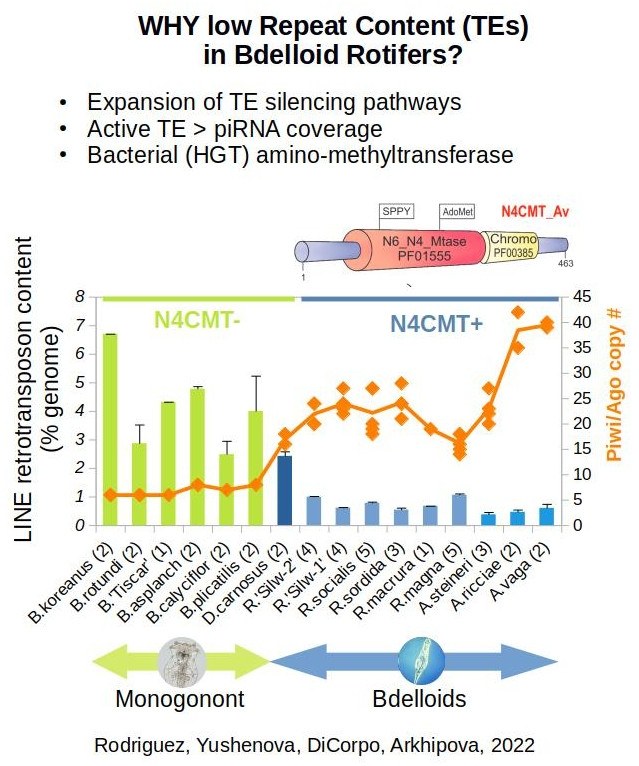
LINE retrotransposon content (% genome) and Piwi/Ago copy numbers in 6 monogonont (green) and 10 bdelloid (blue) rotifer species. Absence or presence of bacterial HGT aminomethyltransferase (N4CMT_Av representation) in the sequenced genome is denoted on top by N4CMT− or N4CMT+, respectively. Median values are indicated by bar heights for LINE content, and by continuous orange line for copy numbers. Data points for % LINE values (+) and copy numbers (◆) are shown for all sequenced isolates from each species, with number of isolates (n) in parentheses. -
*
Reverse-transcriptase-related genes and their biological significance
Retroelements are far more structurally varied than the textbook categories suggest. This work characterizes Penelope-like elements (PLEs) and their relatives: an ancient clade with permuted domain architecture that turns out to be present across the green lineage and protists and to dominate many invertebrate genomes; giant reverse-transcriptase-encoding elements that reside at telomeres; and LTR retrotransposons that have captured extra open reading frames shared across otherwise distant retroelement types.
Mol Biol Evol 2017 · Mol Biol Evol 2021 · Viruses 2017 · Mobile DNA 2013
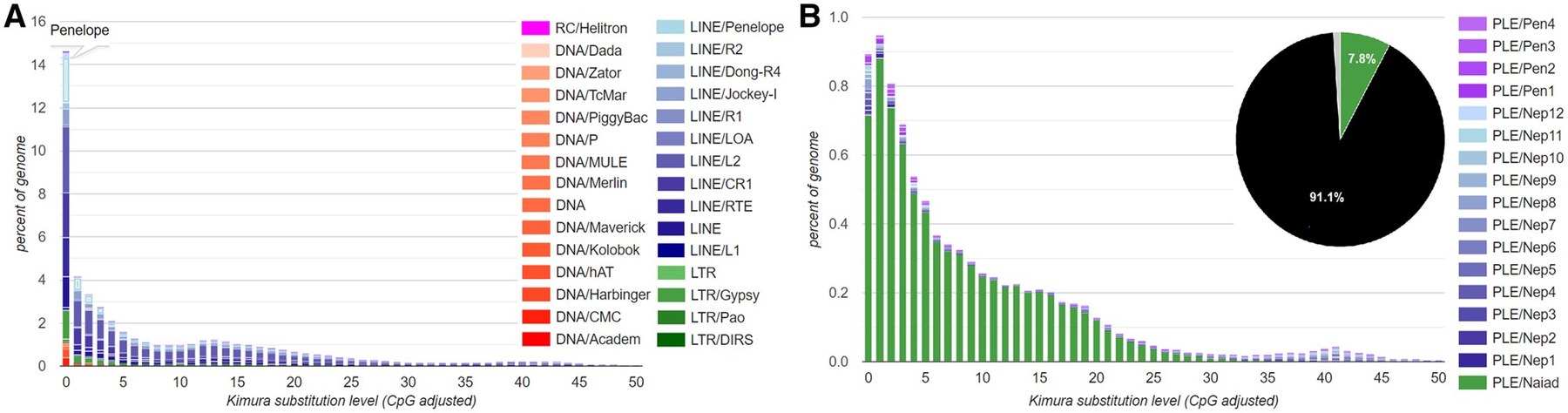
Landscape divergence plots showing TE activity over time and genome occupancy in the acanthocephalan Pomphorhynchus laevis. (A) All TEs, with PLEs on the top (note RepeatMasker classification as LINE/Penelope); (B) PLEs only, subdivided by families, with Naiad_Plae family (PLE/Naiad) occupying most of the space on the divergence plot and on the inserted pie chart. -
*
Mobile genetic elements in sexual and ancient asexual taxa
Theory predicts that transposable elements should behave very differently in lineages that have abandoned sex. Comparative work across bdelloid rotifers and the putatively ancient asexual ostracod Darwinula stevensoni tests that prediction against real genomes, and connects the answer to the silencing machinery, including the expansion of piRNA pathway components that target both transposable elements and foreign genes in Adineta vaga.
eLife 2021 · Genes 2021 · Genetics 2016 · Nature 2013
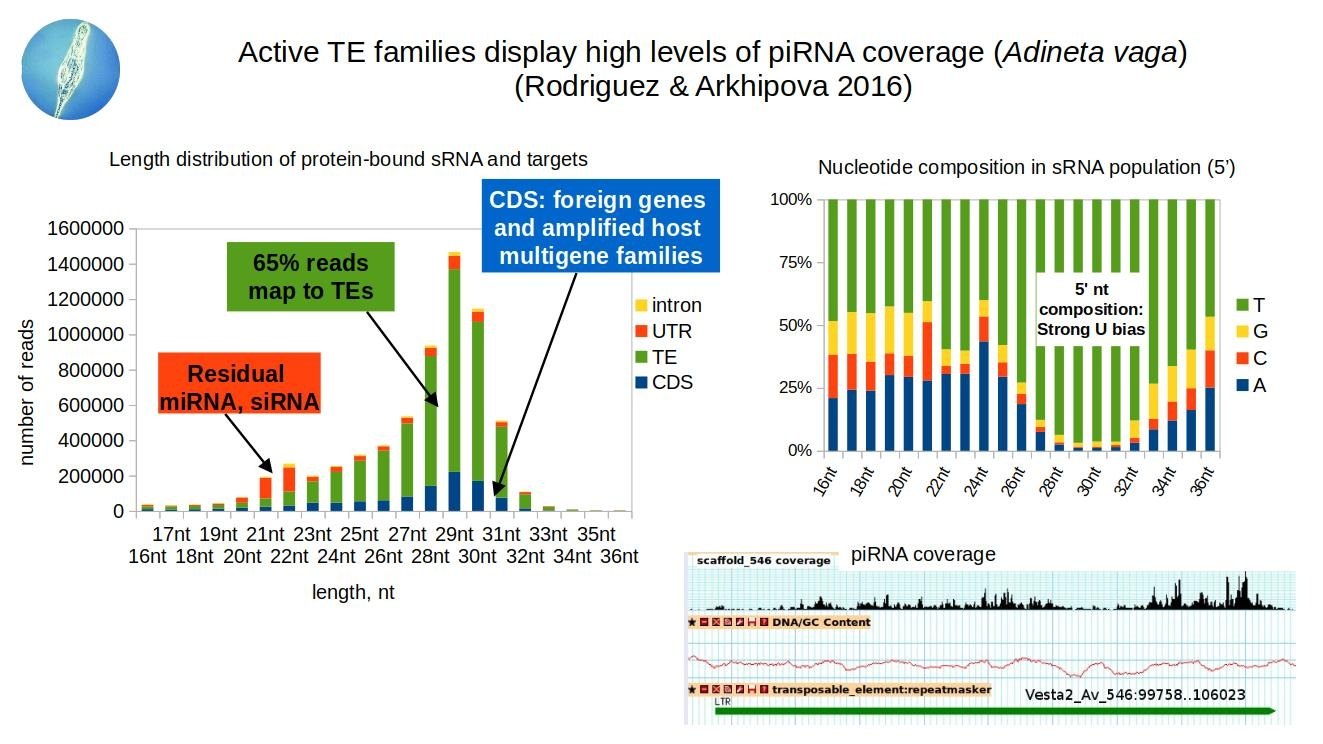
Characterization of protein-bound small RNAs in A. vaga. On the left, length distribution of sRNAs mapped to annotated genomic features (TEs, CDS, UTRs, and introns). The y-axis shows combined read counts for both replicates. Right figure shows percentage of 5’-terminal nucleotides (A, T, G, and C) in each sRNA size class. The bottom right snapshot shows a genome region with small RNA coverage along a selected scaffold with full-length Vesta transposon. -
*
Genetic transformation tools for seagrasses
Establishing a Synthetic Biology and Genome Engineering Platform for the Marine Angiosperm Zostera marina
Seagrasses have no established tissue culture or transformation protocols, which puts most functional genetics out of reach in these species. This work explores the initial steps toward building those tools. Several transformation strategies are being evaluated in parallel, including protoplast-based approaches, callus induction, biolistic delivery and other commonly used methods, developed alongside the foundational tissue culture protocols that are currently unavailable. The project also asks whether the monocot promoters already available are suitable for driving expression of genes of interest in seagrass transformation vectors.
In progress
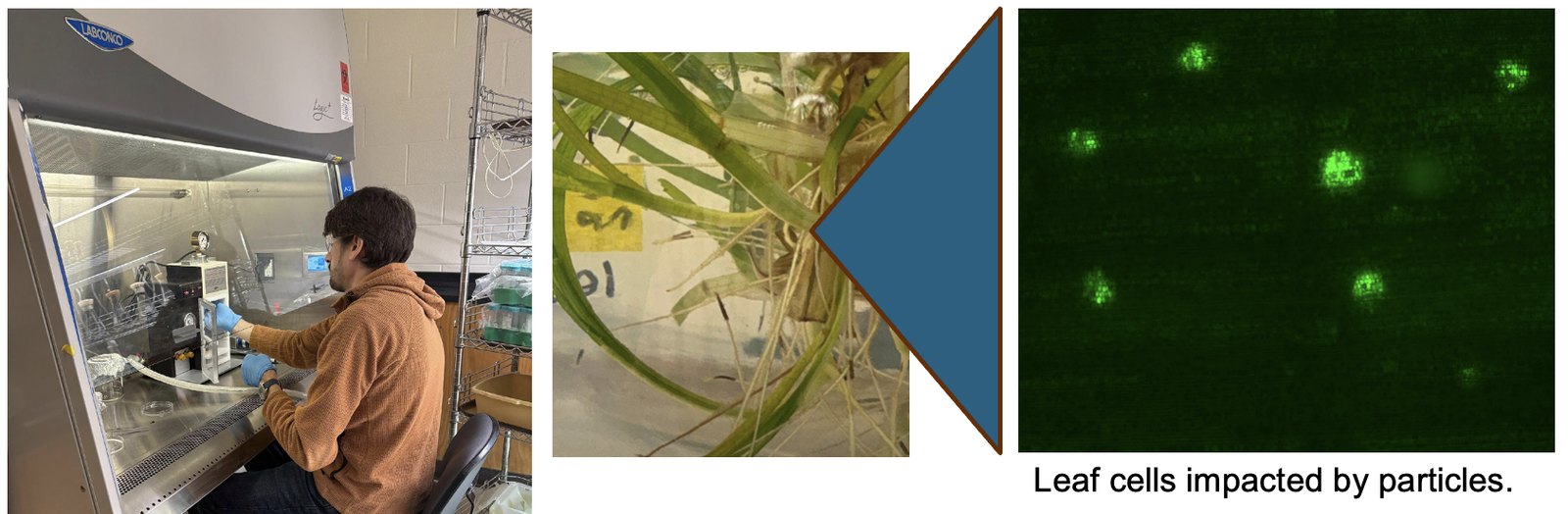
Microprojectile bombardment under the hood.
Working with me
Undergraduate and graduate students interested in genome evolution, transposable elements, or computational approaches to comparative genomics are welcome to get in touch.